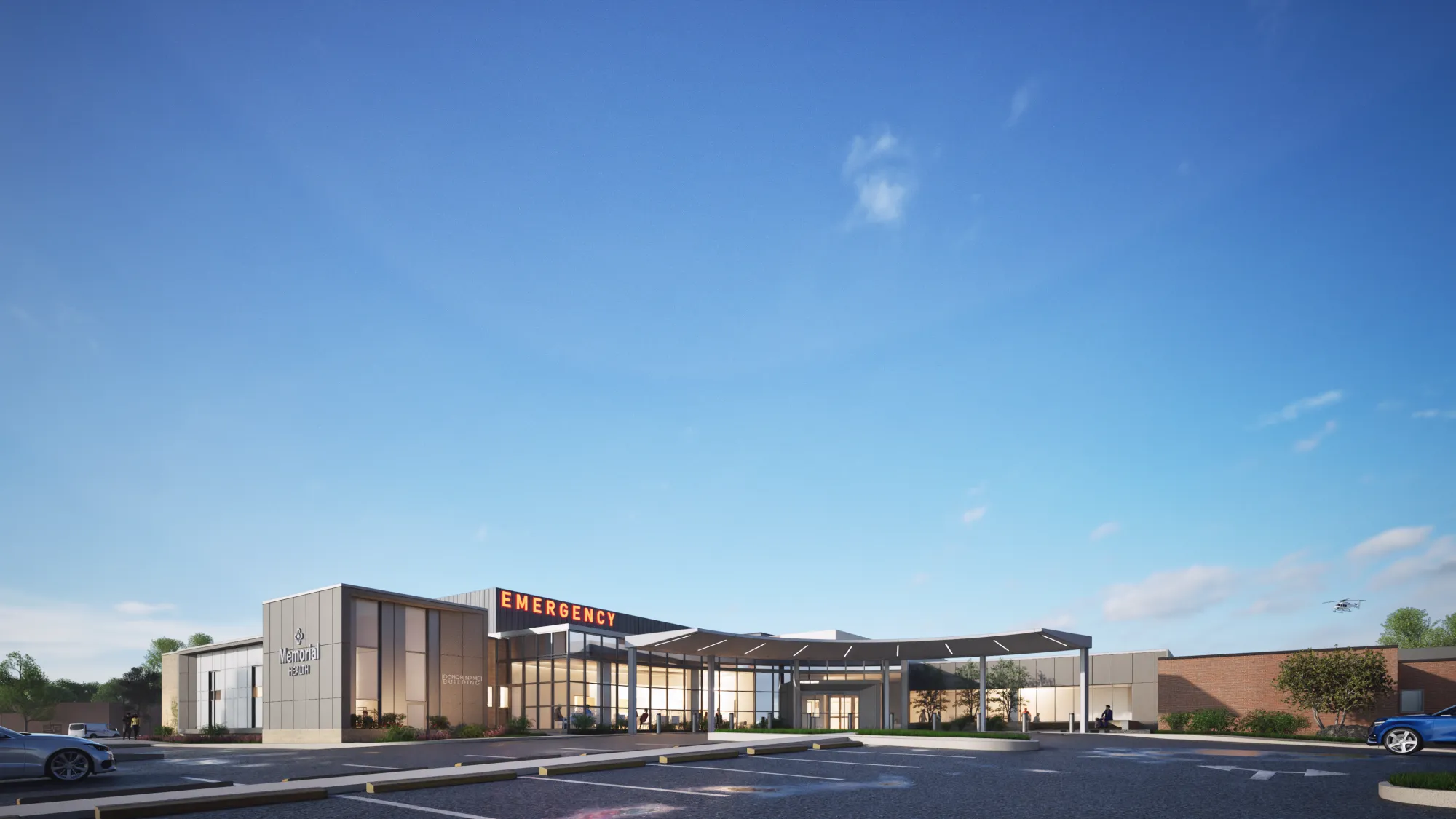
DesignGroup has partnered with healthcare consultant Jon Huddy (Huddy to most) for more than 25 years. Huddy works closely with hospitals, designers and planners during the earliest stages of project work. He facilitates dialog, studies workflow, analyzes performance, and assesses healthcare spaces. He works closely with our healthcare architects at DesignGroup to assist us in defining data-driven and performance focused solutions for our clients.
DesignGroup has partnered with healthcare consultant Jon Huddy (Huddy to most) for more than 25 years. As president of Huddy Healthcare Solutions, a healthcare analytics and planning firm focused on partnering to provide early-phase system analysis and conceptual planning, Huddy works closely with hospitals, designers and planners during the earliest stages of project work. He facilitates dialog, studies workflow, analyzes performance, and assesses healthcare spaces. He works closely with our healthcare architects at DesignGroup to assist us in defining data-driven and performance focused solutions for our clients.
With Huddy’s over 380 emergency department project engagements worldwide, we have been able to add this ED expertise to our highly experienced DesignGroup teams on multiple projects allowing us to position our clients for long-term success.
“Huddy and his team are so valuable to the planning phase of ED design,” says Tom Chidlow, Managing Principal, of DesignGroup, “They’re the best planners in the business because they combine years of experience with a constant focus on the future patient and staff needs.”
In this new interview with DesignGroup’s Heather Clark and Kristyn Svetlak, Huddy discusses how to assess EDs, the partnership with DesignGroup, and the current factors he feels will shape ED design in the future.
Heather: Huddy Healthcare Solutions often provides full operational assessment and scope of planning and programming services. How is your team so successful at quickly adapting to different client needs and project requirements?
Huddy: When we join an ED project, we may provide a full scope of services, including a deep dive into patient care data and operational performance. This initial assessment allows us to better understand project needs, specific patient care needs, and the uniqueness of the hospital’s location including patient/family expectations and cultural needs. We spend a great deal of time in the ED observing flow and talking with the staff and providers. We analyze traffic flow, staffing, coverage, and turnaround times.
By the time we analyze an ED’s existing workflow and start future visioning, the ED staff, doctors/providers, and hospital administrators are all ears because we deliver benchmarks of “like” facilities that allow them to assess where they are with maximizing the use of their existing space, and thus, maximizing their revenue.
Kristyn: What makes your projects successful?
Success comes from the collaboration of our specialized ED consulting team and the hospital’s architect. Working with DesignGroup, we rely heavily on their architectural and design experts to evaluate the facility and assist us in determining the most cost effect change or expansion of facilities. By leveraging DesignGroup’s extensive knowledge of local planning guidelines, we know that whatever solutions we develop will be the best option available.
Another key to success is to make sure the project is focused on each unique client. By clearly understanding the current flow, facility limitations, and the needs (i.e. acuities and patient types) of each ED, we can work with the ED caregivers to help tell the story of the current ED and reveal to hospital leaders and administrators the inner workings of their ED. We encourage hospital leaders (outside of the ED) to sit in on our meetings — ED staff love this because it helps the administration better understand current conditions and their patients’ needs.
By adding applicable facility-like benchmarks and international insights, we can show all participants that they may be unique, but their needs are similar to other EDs who have set success paths forward. This includes our ED database with hundreds of EDs including the multiple DesignGroup/Huddy project partnerships over our 25 years supporting their teams.
Heather: How do your observations and data help in ED planning and decision making around quantities of rooms, furniture, and other investments?
Over multiple decades of focusing on operations-driven ED design, we have developed predictive models which help us test multiple operational and design options. Our models allow us to quantify space needs and define future operational performance based on future patient volumes, acuity distributions, patient flow, and use of space.
We apply our predictive models to show their turnover rate not only for exam rooms, but for capacity amplifiers such as rapid testing areas, vertical recliners, results pending chairs, and extended-stay/observation beds. Our key is to get ED staff to consider amplifying capacity and reducing length of stay time beyond just adding more beds.
We determine their future acuity distributions, and many times this is surprising to the staff since the aging population is driving so much use of the ED. Add in the complexity of the skyrocketing ED mental health patient population, and we know that we need new and innovative solutions beyond more exam rooms. By working with DesignGroup, we have been able to develop and analyze very creative architectural solutions to maximize capacity in limited and challenging spaces with very challenging budgets. Every ED engagement is a multi-level solution, not just a quantity of exam rooms.
Kristyn: Can it be challenging to recommend operational changes to ED staff and leaders? Are they always receptive?
In nearly all cases, they are. We find that ED staff and leaders are problem solvers. Their clinical work means moving swiftly, making rapid decisions, and reacting quickly to findings and results, which may send them down a different care path then they initially expected. We find that with operational flow and space use, many EDs have defined and tested multiple different workflow options within their existing space over the years.
Nothing exposed the ED staffs’ creativity and immediately response to new flow than the onset of the pandemic. Within days, EDs across the US and around the world defined and implemented new workflow, new clinical safety considerations, and a new way to use their current ED space. It’s this inherent creativity of the ED staff that we leverage for every project to work alongside them to define new, move effective workflow to maximize capacity and reduce length of stay times, thus leading to new and innovative architectural designs.
Heather: How does your team assess and consider the interrelationships the ED has with departments like imaging, ICU, or the OR?
In my opinion the ED, like no other department, is tied to the intricate web of services across the entire hospital. Whether its direct support (lab, pharmacy, materials management, security) or operational patient flow between the ED and other departments (such as with imaging, surgery, cath labs, and inpatient beds), or it’s receiving patients from all parts of the hospital who may need immediate emergent care support, the ED is interconnected to nearly all services within the hospital. Since this connectivity across the hospital is a key to the overall success of the ED, we strive to include all applicable departments and specialties within our analysis and planning.
We need to know how a service or department may be changing in the future, and how that chance may impact the ED. In turn, we need to understand how a change in ED patient flow, communications, staffing, technology applications or space use may impact other departments across the hospital.
A huge impact on ED performance is the ability to rapidly access a care space for ED patients. If there are boarding issues with regards to moving admitted patients out of the ED and up to an inpatient unit, it will have direct impact on ED capacity and length of stay times. Understanding house-wide issues within the hospital is always a key component to defining a future successful path for the ED.
Kristyn: As an architect and planner, how do you communicate with the clinical teams? Do they ever challenge you with clinical concerns that you can address adequately and thus gain their buy in to future changes and final architectural design solutions?
I started to focus on ED design back in the mid 1990s, and I learned very quickly that I need to have the ability to better understand the clinical needs of the ED staff, providers, and patients. I started to add ED nurses and doctors to my consulting team and the impact was immediately successful.
My in-house clinical consultants meet face to face with my ED clients and rapidly assess and understand the unique needs of the ED staff and providers. And, in all honesty, my team can challenge the ED staff to consider new and innovative alternatives to how they assess and care for their patients. We usually start with what's working (and not working) with staffing, coverage, communication, and technology. By listening to the ED staff/providers to understand their unique perspective on the current function of the ED, we are then able to talk to them about alternative flow and innovative design options.
Heather: DesignGroup has a great relationship with the state and local approval process. How does this benefit our work with your firm and our project partnerships?
DesignGroup’s knowledge of local codes, guidelines, and the ability to be able to say “we’ve been through this” is fantastic. I find that their knowledge of healthcare design and the intricacies of local governing authorities rival that of any firm, large or small. DesignGroup can point to so many projects in different markets and demonstrate success results through working with local and state agencies.
We literally write that into our sub-consulting contracts — that the architect of record will define and translate the local programming guidelines and planning regulations. We look to DesignGroup for those insights because every state, county and city is different.
Kristyn: What other kinds of challenges factor into planning? We've heard mention of a rise in security considerations. How does your team continue to get in front of all these various aspects? How do you know when to apply best practices, or prioritize unique planning challenges?
We developed a safety and security assessment and planning tool over the years that’s very useful. It covers over 250 items which impact physical security and clinical safety. While it does assess the physical architectural environment of the ED, it also evaluates communication patterns/systems, current technology applications, and staffing/coverage of any applicable security personnel as well as the role of the staff/providers in safety and security.
This analysis highlights the important questions on day one because every operational flow and design decision will have to consider safety and security. The design must not only reflect the basic everyday needs of an ED but also clinical safety considerations for the rare cases we've experienced with Ebola and other infectious diseases. The faster you can get difficult issues on the table for consideration, the more quickly you can realize the need for different flow and design options.
Heather: You mentioned your team’s years of experience working with clinical providers. What has been your latest revelation? Has anything really struck or surprised you lately?
We’ve had the opportunity to work with more than 25 EDs since the onset of the pandemic in 2020. I can tell you that the pandemic was one huge revelatory moment. We were called in to a few EDs to immediately work on new flow for assessment and patient disbursement. On other projects, we were in the middle of the design process and had to rework the designs based on initial lessons-learned regarding patient flow and isolation.
A recent revelation is the data we are now receiving from EDs across the US. The lowest acuity ED patients (emergency severity index (ESI) level 4 and 5 patients) were at an all-time low during the pandemic but that volume is starting to increase as those patients start to return to ED. In a Community Hospital, ESI 4s and 5s pre-pandemic could be as high as 35 to 40% of an EDs volume. We say that 4 and 5 Community Hospital ED volume decrease down to around 18 to 20% during COVID, but now it's coming back. Trauma Centers that may have been at 20% ESI 4s and 5s pre-pandemic dropped to 10-12% during COVID, but now that's coming back. And a lot of EDs converted their lower acuity/rapid turnaround areas to higher acuity zones because they didn't need them during COVID. Now, we need to rethink what the future of lower acuity care areas will be. It’s something we've been watching in the last year.
New challenges to operational flow and design includes the application of Artificial Intelligence (AI) augmented listening and charting in exam rooms. These ambient AI scribes are transforming ED bedside charting as the technology listens to patient-physician conversations and automatically generates clinical notes. Future technologies such as ambient listening will continue to impact the design of clinical spaces with the ED.
Why do you think your collaboration with DesignGroup has led to such successful projects?
The creativity of the DesignGroup, and their willingness to listen to new ideas and innovative architectural solutions lead to fantastic partnerships and great design solutions. I would love to tell you that all architects enjoying partnering with specialists, but that isn’t always the case. DesignGroup seems focused on what’s best for the project, best for the client, and, in turn, what’s best for the patient. We look forward to continuing our relationship with DesignGroup as they continue to be a leader in healthcare planning and design.
Heather Clark is a Senior Interior Designer and Planner with over seven years of experience and has worked on such notable projects as Allegheny General Hospital’s Neurology renovation. Kristyn Svetlak is a Project Associate and Medical Planner with over four years of experience and has worked on notable project such as Allegheny General Hospital’s Emergency Department expansion.